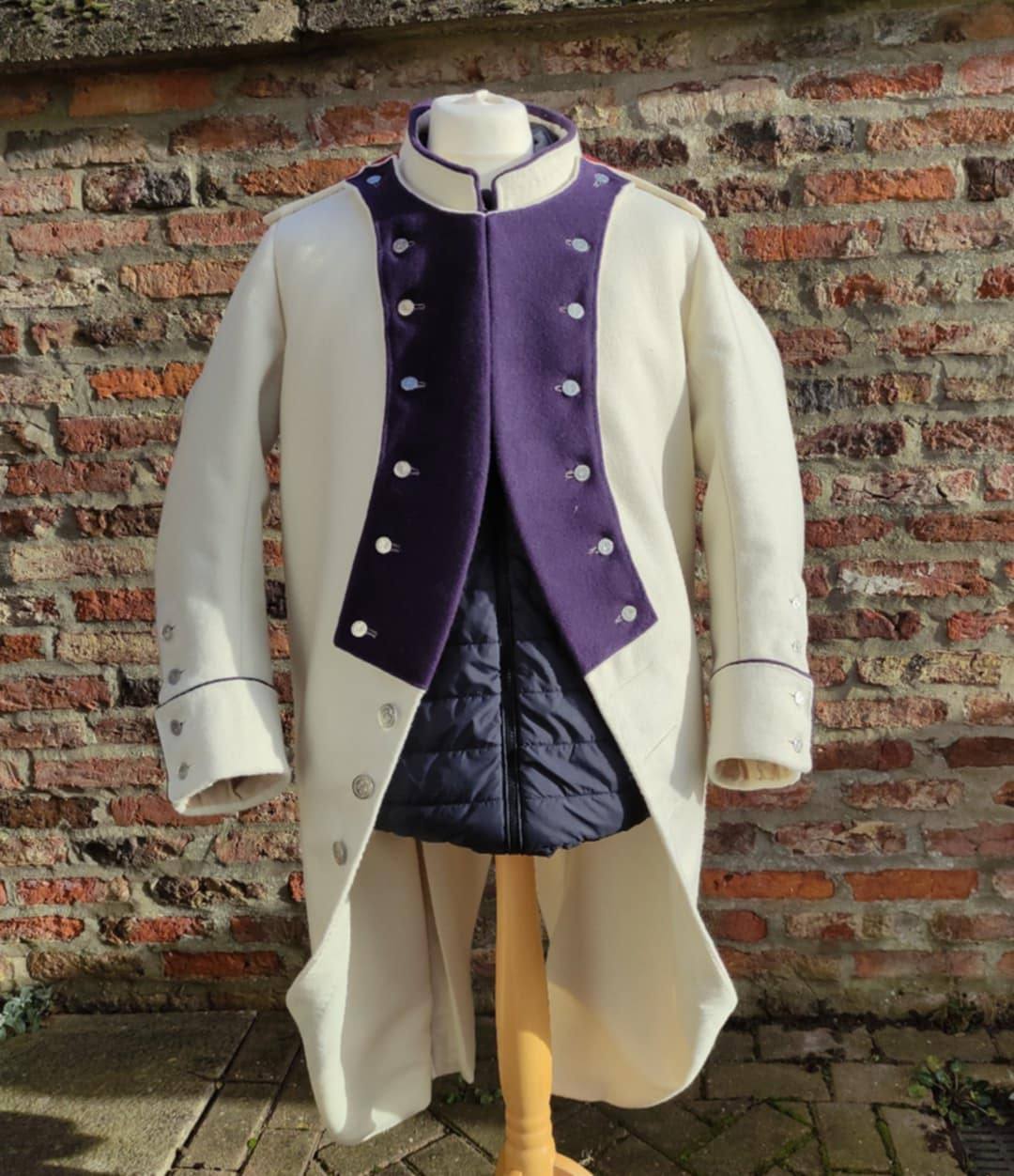
With the first of our regimental coats (or “habit”, pronounced a-bi) completed, we wanted to take the opportunity to talk a little about a few of the finer details. The garment itself is built to last (many of the edges are piped, rather than left raw) and for good reason. The French army only issued a soldat a new one every 3 years, compared to the British annual issue. But why? The answer actually lies in the same reason that the habite is white: because it’s cheap!
The word used in official documentation to refer to this colour was “gris-blanc” (grey-white) and more usually refered to unbleached naturally white wool. This could vary slightly, but was significantly easier (and more cost efficient) to use than to then dye thousands of coats (for the thousands of soldats in the French army at the time).

The other major cost-saving measure was to invest slightly more in their construction, thereby ensuring that a soldat would not need a new habit as often. A regiment would instead rotate through 33% of its men needing a new issue annually, which in turn led to sometimes a significant delay in reglementes being adopted universally. If a man of le Gatinois received his d’Auvergne habit in March of 1776, he would have still been wearing it in Feburary 1779 when the new reglemente came into effect – and he’d have skipped the 1776 reglemente entirely!
One of the particularly special details for us are those which denote our “elite” status as grenadiers. In the French army, aside from our glorious moustaches, sidearms, and the additions to our headwear, the chief distinctions are the grenades on our turnbacks and our red epaulettes (commonly called “shoulder straps” in English, as in modern terminology the original word refers to the later, Napoleonic, style with fringing).
In the 1779 Reglemente, the instructions for the epaulettes are to back them onto white (for strength). The keen-eyed will have also noticed that, unlike many other shoulder strapping, this is sewn into the neck and buttons on the shoulder.

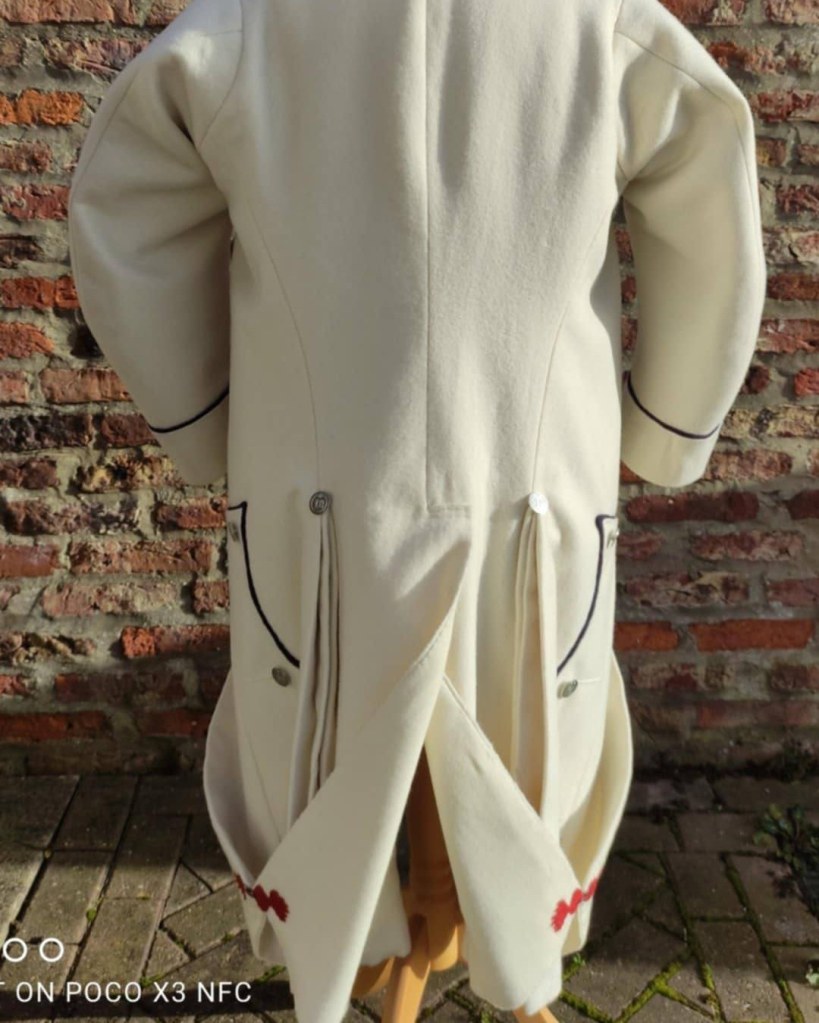
The grenade is taken from the 1786 Reglemente (our thanks to Matthew Keagle for helping us with this detail).
A detail which often confuses those more familiar with British uniforms of our period is how regimental designations worked in the French army. Like the infamous redcoat, they were colour coded, but rather using the whole cuff/lapel along with lacing style and shape, the French treated the revers (lapel) and paramens (cuff) separately.
The regiments were divided into colour groups of 6. 3 would have white metal buttons, and have vertical pockets; 3 would have yellow metal buttons and horizontal pockets. Of these 3, one would have full-coloured revers, one full-coloured paramens, and one both. The detail which was not full coloured would have a coloured passepoil (piping) around the edge. Le Gatinois were part of the third colour group (violet), the second division (white metal and vertical pockets), and were the second (so full-coloured revers, but cuffs only piped).
This serves as yet another example of two different solutions to the same problem, of regimental identification and distinction.

It is these details which we’re pleased to be able to showcase. Not only is accuracy a watchword of #livinghistory, it demonstrates that there was, and is, often more than 1 response to any particular stimulus. Just because an army did things like X, doesn’t mean that everyone did: not better, not worse, just different.
⚜⚜⚜ Vive le Roi! ⚜⚜⚜
Photos by kind permission of Graves Historical Uniforms

 Le Régiment Gatinois