Unlike the British Army, where upon joining a regiment a soldier might be allocated a service number (it wasn’t until 1920 that these were standardised across the whole army), the French Royal Army assigned each new recrue a “nom de guerre” – literally a “name of war”. This would be based upon a soldat’s surname, place of birth, or some physical attribute, and they could often become a central element of their military (and later civilian) identity. They were also all recorded in the personnel register of each regiment! Here you can see two of the Grenadiers of Le Gatinois. Their nom de guerre is denoted by “dit”: Paul Marieu became La Violette (“the violet”) and Reue Bouuot became Bellerose (“beatiful rose”). We wonder what they did to earn those rather pleasant epithets.
One particularly curious example, Charles Francois, who joined Le Bourbonnais in 1777, actually changed his nom de guerre during the French Revolution from “Charleroi” to “Charle” – echoing the removal of the King (le Roi) from France. Putting names to these men helps us understand these were people with their own lives, emotions, hope, and ambitions – and better interpret their experiences during the period of the #americanrevolution.
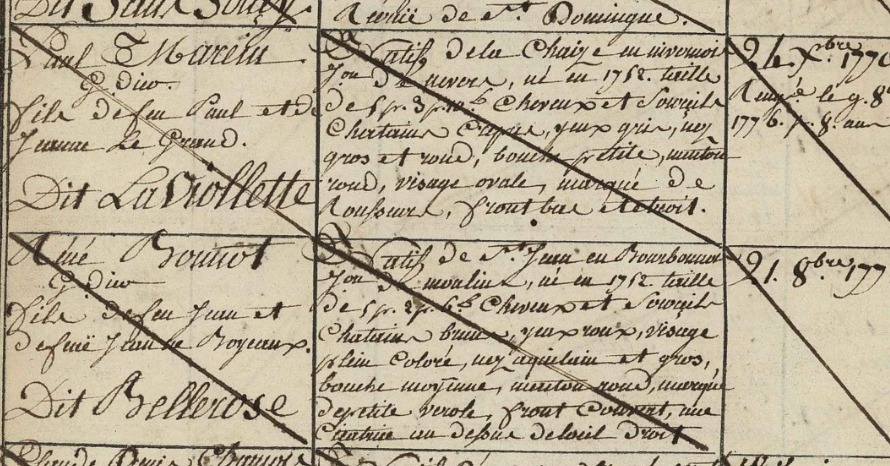
Sources: James Taub, Museum of the American Revoluton; Memoir des Hommes, Ministère des Armées SHD/GR 1 Yc 849

 Le Régiment Gatinois